You took the little sleep gummy, waited for that cozy wave of drowsiness, and… nothing. If you have found yourself staring at the ceiling thinking, why does melatonin not work for me, you are definitely not the only one.
Melatonin has a reputation as a gentle, natural sleep fix, but it is often misunderstood. It is not a knockout pill, and it does not solve every kind of sleep problem. In many cases, it works best when your sleep issue is tied to timing—like jet lag, shift work, or a delayed sleep schedule—not when stress, pain, caffeine, alcohol, anxiety, poor sleep habits, or an underlying sleep disorder is keeping you awake.
That distinction matters because taking more is not always better. Melatonin is a hormone involved in your sleep-wake cycle, and reputable medical sources note that short-term use appears safe for most people, while long-term safety data is still limited. It can also cause side effects such as headache, dizziness, nausea, and daytime sleepiness.
![Image suggestion: A tired person sitting in bed at night, holding a melatonin bottle while looking at a glowing alarm clock.]
What Melatonin Actually Does
Melatonin is a hormone your body naturally makes when darkness signals that night is approaching. Its main job is to help regulate circadian rhythm, which is the internal 24-hour clock that influences when you feel alert and when you feel sleepy. Sleep Education from the American Academy of Sleep Medicine describes melatonin as a hormone naturally produced by the body that plays an important role in sleep and helps regulate the sleep-wake cycle.
That means melatonin is more like a “bedtime signal” than a sedative. A sedative forces drowsiness more directly. Melatonin nudges your biological clock, which is why timing, light exposure, and consistency matter so much.
Definition: Circadian Rhythm
Your circadian rhythm is your body’s internal timing system. It helps coordinate sleep, wakefulness, body temperature, hormones, digestion, and energy levels across the day and night. When your circadian rhythm is aligned, sleep usually comes more naturally. When it is shifted, you may feel wide awake at midnight and exhausted in the morning.
This is one reason the question why does melatonin not work for me often has more to do with timing than with the supplement itself.
why does melatonin not work for me? Common Reasons
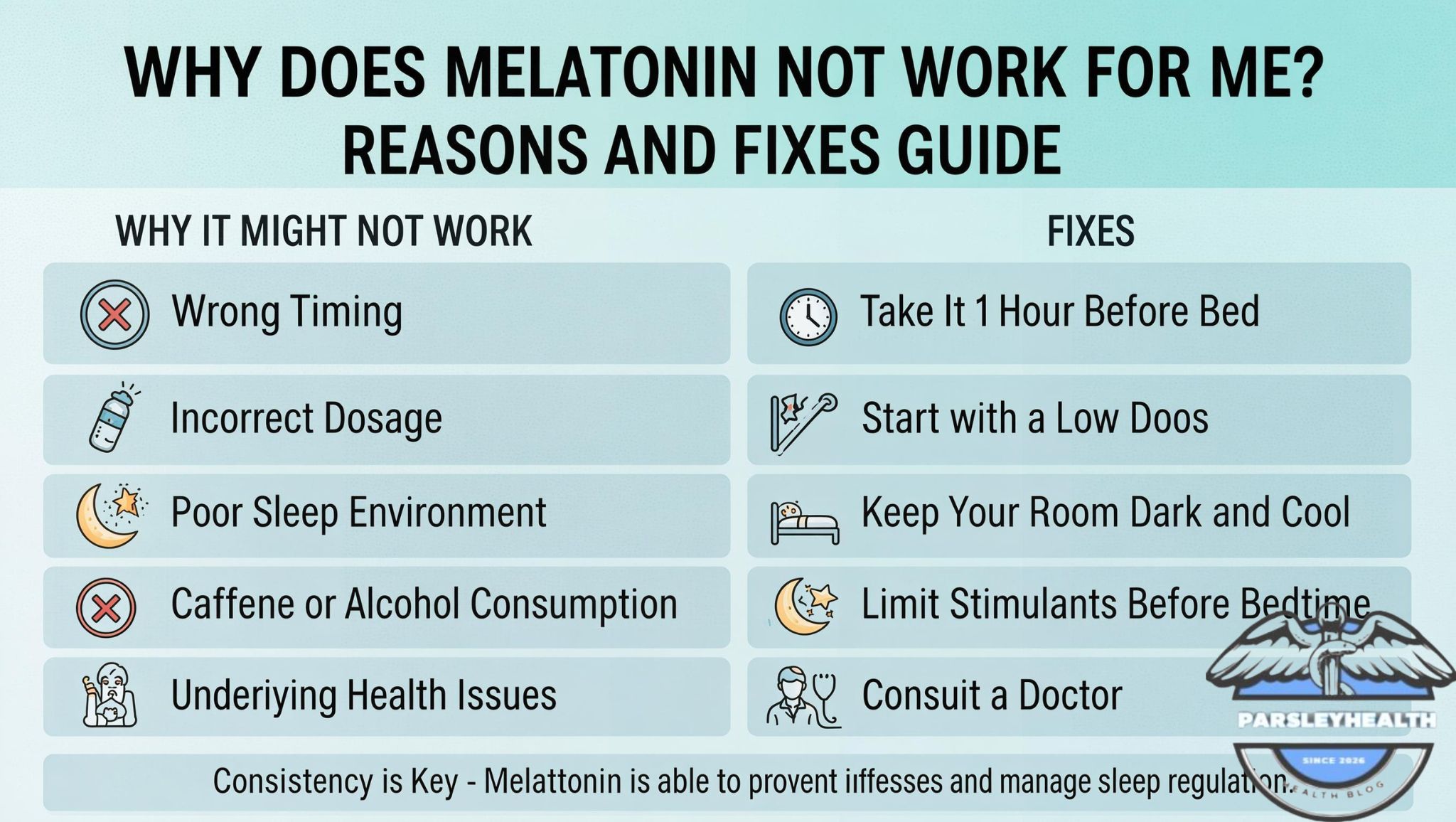
Melatonin can fail for several reasons. Sometimes the dose is wrong. Sometimes the timing is wrong. Sometimes the real issue is not melatonin at all.
You’re Taking It at the Wrong Time
One of the most common mistakes is taking melatonin right before you want to fall asleep and expecting an immediate effect. Some products are marketed like bedtime candy, but melatonin does not always work best that way.
Timing recommendations vary depending on the purpose and formulation. The NHS notes that a usual adult dose for short-term sleep problems may be a 2 mg slow-release tablet taken 1 to 2 hours before bedtime, while other sleep experts and sources discuss different timing for circadian rhythm adjustment.
If your body clock is delayed, taking melatonin too late may miss the window when it could help shift your rhythm. If you take it in the middle of the night, it may leave you groggy the next morning instead of helping you sleep better.
You’re Taking Too Much
Many people assume a higher dose means stronger sleep. That is not always true. Mayo Clinic has warned that higher doses are not necessarily more effective and may increase unwanted effects like daytime sleepiness.
Too much melatonin may cause:
- Morning grogginess
- Vivid dreams
- Headache
- Nausea
- Dizziness
- Irritability
- A “hungover” feeling the next day
This is frustrating because it can feel like the supplement “didn’t work,” when it may have worked at the wrong time, lasted too long, or disrupted your normal rhythm.
Your Sleep Problem Is Not a Melatonin Problem
Melatonin may help some people fall asleep faster or adjust to a new sleep schedule, but it is not a universal insomnia treatment. The American Academy of Sleep Medicine’s clinical practice guideline suggests clinicians not use melatonin for sleep onset or sleep maintenance insomnia in adults.
That does not mean melatonin never helps anyone. It means that for chronic insomnia—especially trouble staying asleep, waking too early, or lying awake with a racing mind—other approaches may be more effective.
You’re Using Screens Too Late
Bright light at night tells your brain it is still daytime. Phones, laptops, tablets, and TVs can delay sleepiness, especially when used close to bed.
The CDC recommends turning off electronic devices at least 30 minutes before bedtime as part of better sleep habits. It also recommends keeping the bedroom quiet, relaxing, and cool.
If you take melatonin and then scroll in bed for an hour, you are giving your brain mixed messages: one signal says “night,” while the other says “stay alert.”
![Image suggestion: Infographic showing “Melatonin Mistakes”: wrong timing, too high dose, late screens, caffeine, alcohol, stress, and untreated insomnia.]
The Timing Problem: Your Body Clock May Be Out of Sync
If you naturally do not feel sleepy until 1 or 2 a.m., melatonin taken at 11:30 p.m. may not be enough to change your rhythm. Your internal clock may already be running late.
This is common in people who:
- Stay up late on weekends
- Sleep in after bad nights
- Work night shifts or rotating shifts
- Travel across time zones
- Get little morning sunlight
- Use bright screens late at night
- Spend most of the day indoors
Morning light and evening darkness are powerful circadian cues. Melatonin may help in some cases, but it works better when your light exposure supports the same goal.
Morning Light Matters More Than People Think
Getting outdoor light early in the day helps anchor your sleep-wake rhythm. The National Sleep Foundation explains that your circadian rhythm is sensitive to light after your usual wake time and before bedtime, and that light exposure affects when your body naturally becomes sleepy.
A practical routine might look like this:
- Get outside within an hour of waking
- Keep lights bright during the morning
- Dim lights in the evening
- Avoid intense screen exposure close to bed
- Keep your bedroom dark while sleeping
This is simple, but it can be surprisingly powerful.
You May Be Expecting Melatonin to Treat Anxiety
A racing mind is one of the most common reasons people cannot sleep. You may feel physically tired but mentally wired. In that situation, asking why does melatonin not work for me makes sense, but melatonin may not be targeting the real problem.
Melatonin does not process worry, resolve stress, or turn off rumination. If your nervous system feels threatened, your brain may keep scanning for problems even after you take a supplement.
Signs Stress Is Driving Your Sleep Trouble
Stress may be the bigger issue if you:
- Feel sleepy on the couch but alert in bed
- Replay conversations at night
- Wake at 3 a.m. with anxious thoughts
- Feel dread about not sleeping
- Check the clock repeatedly
- Sleep better away from home or on weekends
- Notice insomnia during stressful life periods
In this case, the body may need a wind-down routine that lowers arousal before bedtime. That might include journaling, breathing exercises, a warm shower, gentle stretching, prayer, meditation, or reading something calming.
Caffeine Could Be Cancelling Out Your Efforts
Caffeine is not just in coffee. It can show up in tea, energy drinks, pre-workout powders, cola, chocolate, and some medications. Even when caffeine no longer feels “strong,” it may still affect your sleep.
The CDC recommends avoiding caffeine in the afternoon or evening to support better sleep. CDC/NIOSH guidance also suggests avoiding caffeine, chocolate, and nicotine for 5 or more hours before planned sleep, and longer if you are sensitive.
Some people metabolize caffeine slowly. For them, a 2 p.m. coffee can still be active at bedtime.
A Simple Caffeine Test
Try this for 10 to 14 days:
- Keep caffeine before noon.
- Avoid energy drinks and pre-workout stimulants.
- Track sleep onset, night waking, and morning energy.
- Reintroduce afternoon caffeine and compare.
If your sleep improves, melatonin was not the missing piece. Your stimulant timing was.
Alcohol May Help You Doze, Then Ruin Your Sleep
Alcohol can make you feel drowsy at first, which tricks many people into thinking it improves sleep. But it often fragments sleep later in the night.
The CDC recommends avoiding alcohol before bedtime, and the Sleep Foundation notes that alcohol may make it easier to fall asleep at first, but its effects can wear off and disrupt sleep later.
So if you take melatonin after drinking, you may fall asleep but wake at 2 or 3 a.m. That does not necessarily mean melatonin failed. Alcohol may have disrupted your sleep architecture.
Your Product May Not Contain What the Label Says
This is one of the most overlooked answers to why does melatonin not work for me. In the United States, melatonin is regulated as a dietary supplement, not like a prescription drug. NCCIH notes that some products may not contain what is listed on the label; in one 2017 study of 31 supplements, the melatonin amount often did not match the label, and 26% contained serotonin.
NCCIH also reports that a 2023 study found 22 of 25 over-the-counter melatonin gummy products were inaccurately labeled, with melatonin levels ranging from 74% to 347% of the labeled amount among products that contained detectable melatonin.
That means two bottles with the same “dose” may affect you very differently.
What to Look for in a Supplement
If you use melatonin, consider products that are third-party tested by organizations such as USP, NSF, or ConsumerLab. This does not guarantee it will work, but it can reduce the risk of wildly inaccurate labeling.
Also be cautious with gummies, blends, and products that combine melatonin with herbs, magnesium, antihistamines, or other sleep-promoting ingredients. If you react badly, it becomes harder to know what caused the problem.
You Might Be Taking the Wrong Form
Melatonin products can be immediate-release, extended-release, gummies, liquids, tablets, sprays, or capsules. The form matters.
Immediate-release melatonin is generally designed to rise faster and may be more relevant for sleep onset or circadian timing. Extended-release forms last longer and may be used when sleep maintenance is part of the concern, though they can also increase morning drowsiness in some people.
If you wake up groggy, your product may be lasting too long. If you feel nothing at bedtime, your timing, dose, or formulation may not match your sleep pattern.
Your Insomnia May Need CBT-I Instead
For chronic insomnia, the strongest long-term approach is often not a supplement. The American College of Physicians recommends cognitive behavioral therapy for insomnia, known as CBT-I, as the initial treatment for adults with chronic insomnia disorder.
CBT-I is not just “sleep hygiene.” It is a structured treatment that can include sleep restriction, stimulus control, cognitive therapy around sleep anxiety, relaxation skills, and behavior changes. The ACP describes CBT-I as including cognitive therapy, behavioral interventions such as sleep restriction and stimulus control, and education about sleep habits.
What CBT-I Helps With
CBT-I may help if you:
- Lie awake for long periods
- Dread bedtime
- Wake often and struggle to return to sleep
- Spend too much time in bed trying to force sleep
- Depend on sleep aids but still feel unrested
- Have had insomnia for months or years
This is important because why does melatonin not work for me may really mean, “Why does a clock-shifting hormone not fix a learned insomnia pattern?”
Your Bedroom Routine May Be Training Wakefulness
Your brain learns associations. If your bed becomes the place where you scroll, work, worry, watch intense shows, argue, snack, or check the clock, your brain may stop associating bed with sleep.
This can create conditioned arousal. You feel tired before bed, but the moment you lie down, your mind turns on. You ma know about: Hormonal Belly Causes, Symptoms, and Ways to Reduce It.
A Better Bed Rule
Try using the bed mainly for sleep and intimacy. If you cannot sleep after a reasonable period, get out of bed and do something quiet in dim light until sleepiness returns. This is one of the ideas often used in behavioral sleep treatment.
It can feel annoying at first, but it helps retrain the brain: bed means sleep, not struggle.
Medical Issues Can Make Melatonin Seem Useless
Sometimes melatonin is not working because a medical condition is disrupting sleep. This is especially likely if your sleep problem is new, severe, or paired with other symptoms.
Possible contributors include:
- Sleep apnea
- Restless legs syndrome
- Chronic pain
- Acid reflux
- Depression
- Anxiety disorders
- Thyroid disease
- Perimenopause or menopause symptoms
- Frequent nighttime urination
- Medication side effects
If you snore loudly, wake gasping, have morning headaches, or feel sleepy during the day despite enough time in bed, consider asking a healthcare professional about sleep apnea. Melatonin will not keep your airway open.
Medication Interactions and Safety Concerns
Melatonin is often described as natural, but natural does not always mean risk-free. NCCIH advises that people taking medications should consult healthcare providers before using melatonin, especially people with epilepsy or those taking blood thinners. NCCIH also notes limited safety research for pregnancy and breastfeeding and recommends caution in older adults because melatonin may stay active longer and cause daytime drowsiness.
Mayo Clinic lists common side effects such as headache, dizziness, nausea, and drowsiness, and warns against driving or using machinery within five hours of taking melatonin because of possible daytime drowsiness.
Talk to a clinician before using melatonin if you:
- Are pregnant or breastfeeding
- Take blood thinners
- Have epilepsy or seizures
- Take sedatives or sleep medication
- Have dementia or care for someone with dementia
- Have an autoimmune condition
- Are giving it to a child
- Need it nightly for more than a short period
Why Melatonin May Work Once, Then Stop
Some people say melatonin worked beautifully the first night, then stopped. This can happen for several reasons.
First, the original bad night may have been caused by temporary circadian disruption. Once that passed, melatonin had less to “fix.” Second, placebo and expectation can be powerful on the first night. Third, your habits may have changed—more caffeine, later screens, stress, alcohol, or inconsistent wake times.
It is also possible that you became less sensitive to the routine around the supplement, not necessarily the supplement itself. Sleep is highly context-dependent.
A Practical Reset Plan
If you keep asking why does melatonin not work for me, try stepping back and rebuilding the basics for two weeks. This is not exciting, but it often reveals what is really happening.
Step 1: Pick a Consistent Wake Time
Wake up at the same time every day, including weekends. This anchors the body clock better than forcing an early bedtime.
Step 2: Get Morning Light
Spend 10 to 30 minutes outside soon after waking, depending on weather, season, and your schedule. Bright indoor light is better than darkness, but outdoor light is usually stronger.
Step 3: Protect the Evening
Dim lights in the last hour before bed. Reduce screens, or use strong blue-light reduction if screens are unavoidable. The CDC recommends turning off electronics at least 30 minutes before bedtime.
Step 4: Move Caffeine Earlier
Keep caffeine to the morning for two weeks. This one change can dramatically improve sleep for sensitive people.
Step 5: Avoid Alcohol Near Bed
Alcohol may make you sleepy but can disrupt the second half of the night. Try skipping it close to bedtime and observe whether night wakings improve.
Step 6: Use a Wind-Down Ritual
Choose something boring, calming, and repeatable:
- Warm shower
- Gentle stretching
- Reading
- Prayer or meditation
- Breathing exercises
- Journaling worries onto paper
- Relaxing audio
The goal is not to “make yourself sleep.” The goal is to lower arousal.
Step 7: Track What Happens
Write down bedtime, wake time, caffeine, alcohol, exercise, screen use, melatonin timing, and sleep quality. After 10 to 14 days, patterns usually become clearer.
Should You Take More Melatonin?
Usually, increasing the dose should not be the first move. Higher doses can increase side effects without solving the real cause. If you feel nothing at all, the issue may be timing, product quality, light exposure, caffeine, alcohol, stress, or a sleep disorder.
If you are already taking a high dose and still wondering why does melatonin not work for me, that is a sign to reassess rather than keep increasing.
A healthcare professional can help decide whether melatonin is appropriate, what timing makes sense, and whether another evaluation is needed.
What to Try Instead of Relying on Melatonin
The best alternative depends on why you are not sleeping.
If You Cannot Fall Asleep
Focus on circadian rhythm:
- Fixed wake time
- Morning sunlight
- Evening dim light
- Earlier caffeine cutoff
- Less bedtime scrolling
- Calming pre-sleep routine
If You Wake Up at 3 A.M.
Look at alcohol, stress, blood sugar swings, room temperature, sleep apnea symptoms, and anxiety. Melatonin is often less helpful for repeated nighttime waking than for clock-related sleep onset issues.
If You Feel Tired but Wired
Prioritize nervous system downshifting. Try journaling, breathwork, progressive muscle relaxation, gentle yoga, therapy, or CBT-I.
If You Sleep Enough but Wake Unrefreshed
Consider sleep quality problems such as sleep apnea, restless legs, medication effects, or mood disorders. A sleep evaluation may be more useful than another supplement.
FAQ
why does melatonin not work for me even when I take it every night?
It may not work because your sleep problem is not caused by low melatonin. Timing mistakes, high doses, caffeine, alcohol, screen exposure, stress, insomnia patterns, product quality, or an underlying sleep disorder can all interfere.
Can you be resistant to melatonin?
Some people seem less responsive to melatonin, but “resistance” is not always the right explanation. Often, the supplement is being taken at the wrong time, the dose is too high, the product is unreliable, or the real sleep issue requires a different treatment.
How long does melatonin take to work?
It depends on the formulation and the reason you are taking it. Some people feel sleepy within 30 to 60 minutes, while circadian rhythm adjustment may require different timing. The NHS describes a usual slow-release adult dose as being taken 1 to 2 hours before bedtime for short-term sleep problems.
Is it bad if melatonin does not make me sleepy?
Not necessarily. Melatonin is not supposed to knock you out like a sedative. It is more of a timing signal for your body clock. If you do not feel sleepy, your circadian rhythm, stress level, light exposure, or sleep habits may be overpowering the signal.
Can too much melatonin keep you awake?
For some people, yes. A high dose may cause grogginess, vivid dreams, fragmented sleep, or a strange wired feeling. Higher doses are not always more effective and may increase side effects.
Is melatonin good for anxiety-related insomnia?
Melatonin may not be enough if anxiety is the main reason you cannot sleep. Stress and worry often require relaxation skills, therapy, CBT-I, lifestyle changes, or medical support. Melatonin does not directly resolve anxious thoughts.
Should I stop taking melatonin if it does not work?
If it consistently does not help, causes side effects, or you need it nightly for a long time, it is reasonable to pause and speak with a healthcare professional. Long-term safety data is limited, and chronic insomnia often responds better to CBT-I.
What is the best natural way to sleep better without melatonin?
Start with a consistent wake time, morning sunlight, less caffeine later in the day, reduced alcohol near bedtime, a cool dark bedroom, and a calming wind-down routine. The CDC recommends consistent sleep and wake times, a quiet and cool bedroom, turning off devices before bed, avoiding alcohol and large meals before bed, avoiding afternoon or evening caffeine, and exercising regularly.
Conclusion
If you keep wondering why does melatonin not work for me, the answer is probably not that your body is broken. Melatonin may simply be the wrong tool for the job, or it may be used at the wrong time, in the wrong dose, or against habits that keep your brain alert.
The most useful shift is to stop treating melatonin like a magic sleep switch. Think of it as one possible circadian signal. It works best when your light exposure, wake time, caffeine habits, evening routine, and stress levels are all pointing in the same direction.
If sleep problems are occasional, basic habit changes may be enough. If insomnia is chronic, CBT-I and medical evaluation are worth considering. And if symptoms like loud snoring, gasping, restless legs, severe anxiety, depression, pain, or extreme daytime sleepiness are part of the picture, it is better to investigate the root cause than keep raising the dose.