Seeing a high number on a blood test can make your stomach drop, especially when the report uses words like “elevated,” “abnormal,” or “inflammation.”
If you are wondering how much crp level is dangerous, the answer depends on the number, the unit, your symptoms, and why the test was ordered. A mildly raised CRP may point to low-grade inflammation, while a very high CRP can happen with serious infection, major injury, autoimmune flares, or other urgent medical problems.
CRP is helpful, but it is not a diagnosis by itself. It tells you that inflammation is likely happening somewhere in the body; it does not automatically tell you where, why, or how dangerous it is.
That is why context matters. A CRP result should be interpreted with your symptoms, medical history, physical exam, and sometimes other tests such as CBC, ESR, blood cultures, imaging, or repeat CRP testing.
What Is CRP?
CRP stands for C-reactive protein. It is a protein made by the liver, and its level rises when there is inflammation in the body. MedlinePlus describes CRP as an acute phase reactant, meaning it goes up in response to inflammation.
Inflammation is not always bad. It is part of the body’s defense system. CRP may rise when your immune system is responding to infection, tissue injury, autoimmune activity, inflammatory disease, or major stress on the body.
The important point is that CRP is nonspecific. It can show that inflammation exists, but it usually cannot identify the exact cause without more information.
Standard CRP vs hs-CRP
There are two common CRP-related tests:
- Standard CRP: Used to detect or monitor general inflammation, infection, autoimmune disease, injury, or inflammatory conditions.
- High-sensitivity CRP, or hs-CRP: Used to measure lower levels of inflammation, often for cardiovascular risk assessment.
This distinction matters because a number that sounds “high” on an hs-CRP report may mean something different from a high number on a standard CRP test.
How CRP Is Measured
CRP is commonly reported in milligrams per liter, written as mg/L. Some labs may report it in milligrams per deciliter, written as mg/dL.
This can be confusing because the numbers look different depending on the unit.
CRP Unit Conversion
The basic conversion is:
1 mg/dL = 10 mg/L
So:
- 1 mg/dL equals 10 mg/L
- 5 mg/dL equals 50 mg/L
- 10 mg/dL equals 100 mg/L
Before asking how much crp level is dangerous, check the unit on your report. A CRP of 10 mg/L and a CRP of 10 mg/dL are not the same. One is moderately high; the other is much higher.
How Much CRP Level Is Dangerous?
There is no single CRP number that is dangerous for everyone. A CRP level becomes more concerning when it is very high, rising quickly, persistent, or paired with serious symptoms such as fever, chest pain, shortness of breath, confusion, severe weakness, severe abdominal pain, or signs of sepsis.
Mayo Clinic notes that CRP is measured in mg/L and that results equal to or greater than 8 mg/L or 10 mg/L are generally considered high, though ranges vary by lab.
Cleveland Clinic says a CRP result above 10 mg/dL is generally considered a marked elevation, and severe elevations above 50 mg/dL are strongly associated with acute bacterial infections. The same article also notes that results over 50 mg/L are associated with acute bacterial infections about 90% of the time, though the page appears to mix mg/dL and mg/L wording in places, so the unit on your own lab report is essential.
Practical CRP Level Chart
| CRP Level | What It May Mean |
|---|---|
| Less than 1 mg/L | Low inflammation in many contexts |
| 1–3 mg/L | Mild low-grade inflammation; used in hs-CRP heart-risk interpretation |
| 3–10 mg/L | Mild to moderate elevation; may occur with obesity, smoking, chronic inflammation, minor infection, or other factors |
| 10–50 mg/L | More significant inflammation; may occur with infection, inflammatory disease, injury, or flare-ups |
| 50–100 mg/L | High elevation; bacterial infection, serious inflammation, or tissue injury becomes more concerning |
| Over 100 mg/L | Very high; often needs prompt medical evaluation, especially with symptoms |
| Over 200 mg/L | Severe inflammation; can occur with serious bacterial infection, sepsis, major trauma, or severe inflammatory disease |
This chart is a guide, not a diagnosis. A person with CRP 30 mg/L and severe symptoms may need urgent care, while someone with CRP 30 mg/L after surgery may be interpreted differently.
Why a “Dangerous” CRP Depends on Symptoms
CRP is not like blood sugar, oxygen level, or potassium, where certain values can be immediately dangerous by themselves. CRP is a signal. The danger comes from what is causing the inflammation.
A CRP of 80 mg/L with fever, low blood pressure, and confusion is far more urgent than a CRP of 80 mg/L in someone already being treated and improving after a known infection.
Symptoms That Make High CRP More Concerning
Seek prompt medical advice if a high CRP comes with:
- Fever or chills
- Shortness of breath
- Chest pain or pressure
- Confusion
- Fainting or severe dizziness
- Severe abdominal pain
- Persistent vomiting
- Severe headache with stiff neck
- Rapid heartbeat
- Low blood pressure
- New weakness on one side
- Severe back pain with fever
- Red, hot, swollen skin
- Painful urination with fever
- Worsening symptoms after surgery
If you feel seriously unwell, do not wait for a repeat test.
Normal CRP Range
Different labs use slightly different reference ranges, but CRP is usually low in healthy people. MedlinePlus says a value of 0.8–1.0 mg/dL or lower is generally considered a healthy amount, which equals about 8–10 mg/L.
Mayo Clinic similarly states that CRP results equal to or above 8 mg/L or 10 mg/L are considered high by many labs.
Why Lab Ranges Differ
Your report may show a normal range such as:
- Less than 3 mg/L
- Less than 5 mg/L
- Less than 8 mg/L
- Less than 10 mg/L
This does not always mean one lab is right and another is wrong. Testing methods, patient population, and clinical use can vary. Always compare your number with the reference range printed on your own report.
hs-CRP and Heart Risk
High-sensitivity CRP is different from standard CRP because it measures lower levels more precisely. It is often used to help assess cardiovascular risk, not to diagnose an acute infection.
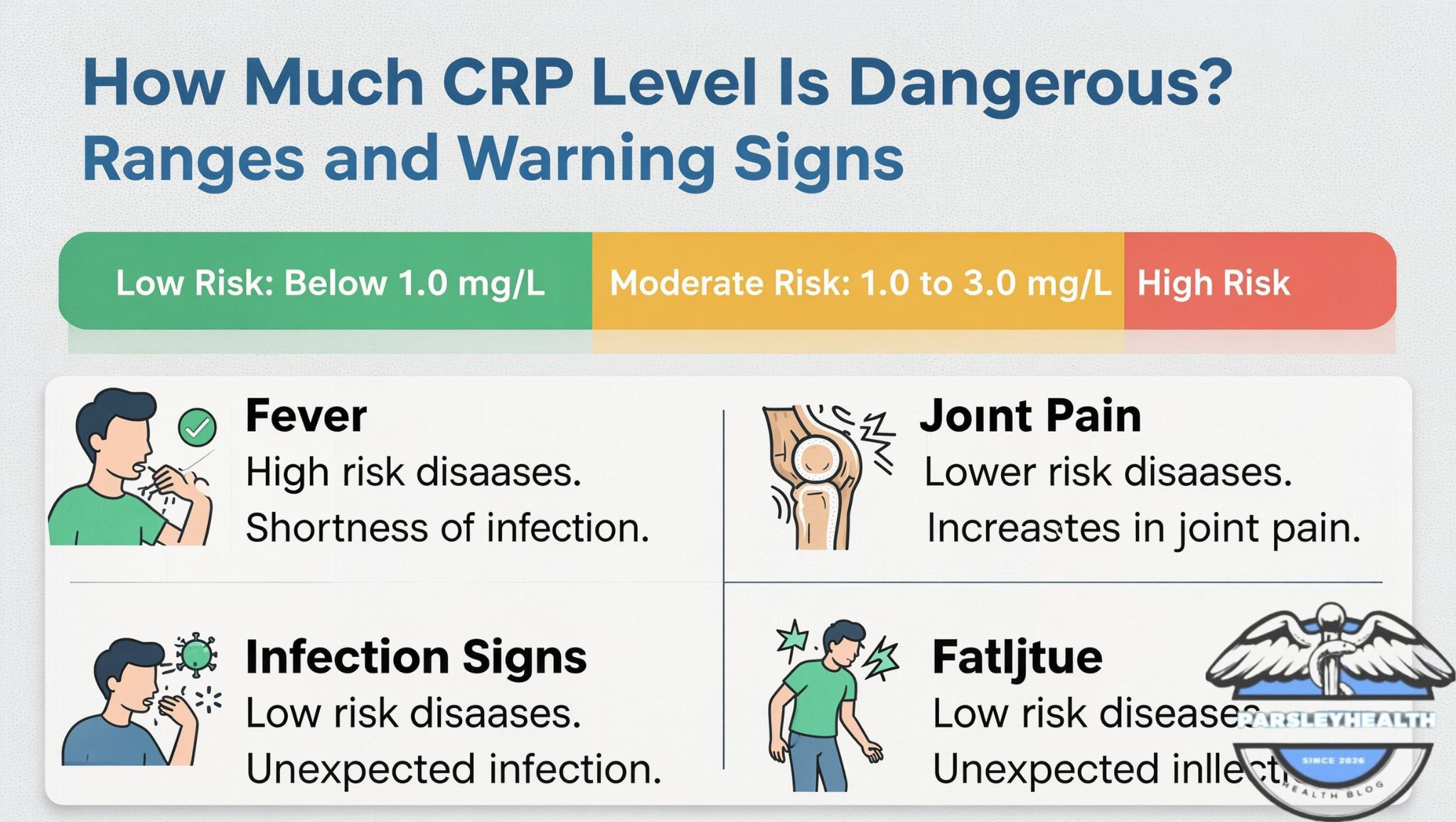
Cleveland Clinic Laboratories lists hs-CRP cardiovascular risk categories as less than 1.0 mg/L for low relative risk, 1.0–3.0 mg/L for average or intermediate risk, and more than 3.0 mg/L for high relative risk.
hs-CRP Heart Risk Categories
| hs-CRP Level | Cardiovascular Risk Category |
|---|---|
| Less than 1 mg/L | Lower risk |
| 1–3 mg/L | Average or intermediate risk |
| More than 3 mg/L | Higher risk |
| More than 10 mg/L | May suggest infection or another inflammatory cause; often repeated later |
If hs-CRP is above 10 mg/L, it may not be useful for heart-risk interpretation until infection, injury, or inflammation is ruled out or resolved.
hs-CRP Does Not Work Alone
A high hs-CRP does not mean you will have a heart attack. It is one marker among many. Doctors interpret it alongside cholesterol, blood pressure, smoking status, diabetes, age, family history, weight, kidney function, and other risk factors.
Common Causes of High CRP
CRP rises when the body detects inflammation. The possible causes are broad, which is why a high result often leads to more questions.
Infections
Infections are a major cause of elevated CRP. Bacterial infections often raise CRP more than mild viral infections, but there is overlap.
Possible infection-related causes include:
- Pneumonia
- Urinary tract infection
- Kidney infection
- Appendicitis
- Diverticulitis
- Skin infection or cellulitis
- Abscess
- Sepsis
- Bone infection
- Pelvic infection
- Severe dental infection
A very high CRP with fever, chills, weakness, low blood pressure, or confusion needs urgent medical attention.
Autoimmune and Inflammatory Diseases
CRP can rise during inflammatory disease activity. Examples include:
- Rheumatoid arthritis
- Lupus, though CRP may be variable
- Inflammatory bowel disease
- Vasculitis
- Polymyalgia rheumatica
- Psoriatic arthritis
- Ankylosing spondylitis
Doctors may use CRP to monitor disease activity or response to treatment, but it is usually not the only marker.
Injury, Surgery, and Trauma
CRP can rise after tissue damage, including surgery, fractures, burns, or major injury. In these cases, the trend matters. CRP may rise after the event and then fall as healing progresses.
If CRP rises again after surgery or injury, especially with fever or worsening pain, infection may need to be considered.
Chronic Low-Grade Inflammation
Mildly elevated CRP can be linked with chronic low-grade inflammation. MedlinePlus notes that CRP increases above normal can also be linked with factors such as insomnia, depression, hormone replacement therapy, obesity, and sex, with females often having slightly higher CRP levels than males.
Other contributors may include smoking, untreated gum disease, poor sleep, metabolic syndrome, diabetes, and chronic inflammatory conditions.
CRP Levels Above 10 mg/L
When people ask how much crp level is dangerous, 10 mg/L is often the first number that appears in lab reports as “high.”
A CRP above 10 mg/L means inflammation is likely present, but it does not automatically mean danger. It may happen with a cold, flu-like illness, mild infection, injury, chronic inflammatory condition, or recent vaccination. It may also happen after intense exercise or tissue stress in some cases.
What to Do With CRP Above 10 mg/L
A doctor may consider:
- Your symptoms
- Temperature
- Heart rate and blood pressure
- Complete blood count
- ESR
- Urine test
- Chest exam or chest X-ray
- Medication history
- Autoimmune symptoms
- Repeat CRP testing
If you feel well and the elevation is mild, your clinician may repeat the test later. If you feel unwell, they may investigate immediately.
CRP Levels Above 50 mg/L
A CRP above 50 mg/L is more concerning than a mild elevation. It often suggests a stronger inflammatory process, such as bacterial infection, inflammatory flare, tissue injury, or another significant condition.
Cleveland Clinic describes severe CRP elevation as commonly associated with acute bacterial infections, especially at very high levels.
When CRP Above 50 Needs Faster Attention
Contact a healthcare professional promptly if CRP above 50 mg/L comes with:
- Fever
- Chills
- Worsening pain
- Cough with breathing difficulty
- Burning urination with flank pain
- Red swollen skin
- Severe sore throat
- Abdominal pain
- Recent surgery
- Weakness or confusion
CRP alone is not an emergency, but CRP plus concerning symptoms can be.
CRP Levels Above 100 mg/L
A CRP above 100 mg/L is usually considered very high. It often points toward significant infection, severe inflammation, major tissue injury, or an active inflammatory disease flare.
This is where the question how much crp level is dangerous becomes more urgent. A CRP above 100 mg/L should generally be discussed with a healthcare professional, especially if you do not already know the cause.
Possible Causes of CRP Above 100
Potential causes include:
- Bacterial pneumonia
- Kidney infection
- Sepsis
- Severe cellulitis
- Abscess
- Appendicitis
- Diverticulitis
- Active inflammatory bowel disease
- Rheumatologic flare
- Major trauma
- Recent major surgery
- Severe pancreatitis
If you have a CRP above 100 mg/L and feel very sick, seek urgent care.
CRP Levels Above 200 mg/L
A CRP above 200 mg/L is a major elevation and often indicates a serious inflammatory process. It may occur in severe bacterial infection, sepsis, major trauma, serious abdominal infection, severe pneumonia, or other significant conditions.
The exact level still does not diagnose the cause. But at this range, clinicians usually take the result seriously and look for an explanation quickly.
Do Not Interpret This Alone
If your CRP is above 200 mg/L, contact your doctor urgently, especially if you have fever, severe pain, weakness, confusion, breathing symptoms, or rapid worsening.
Can CRP Be High Without Infection?
Yes. CRP can be high without infection. Inflammatory diseases, autoimmune disorders, tissue injury, surgery, burns, cancer, obesity, smoking, chronic kidney disease, and other conditions can raise CRP.
That is why antibiotics are not automatically appropriate for high CRP. The cause must be identified first.
Examples of Non-Infection Causes
High CRP may occur with:
- Rheumatoid arthritis flare
- Inflammatory bowel disease flare
- Vasculitis
- Recent surgery
- Heart attack or tissue injury
- Severe pancreatitis
- Trauma
- Some cancers
- Obesity-related inflammation
- Smoking-related inflammation
The treatment depends on the cause, not the number alone.
Can CRP Be Normal During Illness?
Yes. A normal CRP does not always rule out disease. CRP may be normal early in an illness, in some localized infections, in certain autoimmune conditions, or in people whose inflammatory response is blunted.
Some conditions are better detected with other tests. For example, a complete blood count, ESR, procalcitonin, urine test, imaging, cultures, or condition-specific antibodies may be more useful depending on symptoms.
CRP vs ESR
CRP and ESR are both inflammation markers, but they behave differently.
CRP often rises and falls more quickly. ESR may change more slowly and can be affected by age, anemia, pregnancy, kidney disease, and other factors.
Why Doctors Order Both
A doctor may order CRP and ESR together to understand inflammation patterns. For example:
- CRP may rise quickly with acute infection.
- ESR may remain elevated longer in some chronic inflammatory diseases.
- A mismatch between CRP and ESR can sometimes provide clues.
Neither test tells the full story alone.
CRP and COVID, Flu, or Viral Illness
CRP can rise during viral infections, including respiratory infections. Mild viral illness may cause a mild to moderate rise, while more severe infection or complications can raise it higher.
A high CRP during a viral illness may prompt clinicians to consider severity, secondary bacterial infection, pneumonia, or other complications. But CRP alone cannot distinguish every viral illness from bacterial illness.
CRP and Autoimmune Disease Monitoring
For people with known inflammatory disease, CRP may be used to track flares or treatment response.
For example, if someone with rheumatoid arthritis has joint swelling and CRP rises, that may support active inflammation. If treatment works, CRP may fall.
But some autoimmune diseases do not always raise CRP dramatically. Symptoms, physical exam, imaging, and other labs still matter.
CRP and Cancer
CRP can be elevated in some cancers because cancer may trigger inflammation, tissue injury, infection risk, or immune activity. However, CRP is not a cancer screening test.
A high CRP does not mean you have cancer. It means inflammation is present and needs interpretation in context.
If CRP is persistently elevated without a clear cause, doctors may investigate based on age, symptoms, exam findings, and other lab abnormalities. You may read this: Hashimoto’s Flare Up: Symptoms, Triggers and Relief Tips.
What If Your CRP Is Mildly High?
A mildly high CRP can be frustrating because it may not point to one clear answer. Testing.com notes that minor elevations can be difficult to interpret and may not necessarily mean an illness requiring treatment.
Mild elevation may be linked with:
- Recent cold or infection
- Poor sleep
- Obesity
- Smoking
- Gum disease
- Chronic stress
- Depression
- Hormone therapy
- Minor injury
- Recent vaccination
- Intense exercise
- Early inflammatory disease
Your doctor may repeat the test after a few weeks, especially if you had a recent illness.
What If Your CRP Is Very High but You Feel Fine?
Sometimes CRP is unexpectedly high when someone does not feel very sick. This should not be ignored, but it also should not cause panic.
Possible explanations include a recent infection, hidden infection, inflammatory condition, dental infection, urinary infection, recent injury, medication effects, or lab timing.
What Doctors May Do Next
A clinician may repeat the CRP and order additional tests such as:
- Complete blood count
- ESR
- Liver and kidney function
- Urinalysis
- Blood cultures, if infection is suspected
- Chest X-ray
- Autoimmune tests
- Stool tests, if bowel symptoms exist
- Dental evaluation, if symptoms suggest it
The next step depends on the whole picture.
How Fast Can CRP Change?
CRP can rise fairly quickly after inflammation begins and may fall as inflammation improves. This makes it useful for monitoring some infections and inflammatory conditions.
A falling CRP can suggest improvement, but it must match the clinical picture. If the patient looks worse despite a falling CRP, doctors do not rely on CRP alone.
Trends Matter More Than One Number
A single CRP result is a snapshot. A trend can tell a story.
For example:
- CRP 120 → 80 → 30 may suggest improvement.
- CRP 20 → 60 → 150 may suggest worsening inflammation.
- CRP staying mildly elevated for months may suggest chronic inflammation or an unresolved cause.
How to Lower CRP
The best way to lower CRP is to treat the cause. If CRP is high because of pneumonia, the answer may be infection treatment. If it is high because of rheumatoid arthritis, the answer may be controlling the autoimmune disease. If it is high because of smoking, obesity, poor sleep, or gum disease, lifestyle and targeted care matter.
Lifestyle Steps That May Help Low-Grade CRP
For chronic mild elevation, helpful habits may include:
- Quitting smoking
- Treating gum disease
- Improving sleep
- Managing weight if needed
- Eating more fiber-rich foods
- Choosing fruits and vegetables daily
- Eating fatty fish or other omega-3 sources
- Reducing ultra-processed foods
- Exercising consistently
- Managing blood sugar
- Treating chronic conditions
- Reducing alcohol if intake is high
These steps are not emergency treatment for very high CRP. They are long-term inflammation support.
Foods That May Support Lower Inflammation
Diet alone will not fix every CRP elevation, but a nutrient-rich eating pattern may help reduce chronic low-grade inflammation.
Helpful Foods
Consider adding:
- Leafy greens
- Berries
- Beans and lentils
- Oats
- Whole grains
- Olive oil
- Nuts
- Seeds
- Fatty fish
- Yogurt or fermented foods
- Colorful vegetables
- Herbs and spices
- Citrus fruits
This kind of eating pattern supports heart health, gut health, blood sugar, and overall inflammatory balance.
What Not to Do With a High CRP Result
A high CRP can make people want to act immediately, but some reactions are not helpful.
Avoid:
- Starting antibiotics without diagnosis
- Taking steroids unless prescribed
- Ignoring fever or severe symptoms
- Assuming it is cancer
- Assuming it is “just stress”
- Comparing your number to someone else’s without context
- Forgetting to check the unit
- Repeating the test too soon without medical guidance
- Using supplements instead of medical evaluation for very high CRP
The question how much crp level is dangerous is important, but the better question is: what is causing this result in this person, right now?
When to Seek Urgent Medical Care
Get urgent care if a high CRP comes with symptoms that suggest serious infection, heart problems, severe inflammation, or organ involvement.
Urgent Symptoms
Seek help quickly for:
- Chest pain
- Trouble breathing
- Blue lips
- Confusion
- Fainting
- Severe weakness
- Very high fever
- Stiff neck
- Severe headache
- Severe abdominal pain
- Persistent vomiting
- Signs of dehydration
- Rapidly spreading skin redness
- Severe back pain with fever
- Low blood pressure
- Fast heart rate with feeling very ill
If you have these symptoms, the exact CRP number is less important than getting assessed.
Questions to Ask Your Doctor
When reviewing your CRP result, ask:
- Is this standard CRP or hs-CRP?
- What unit is it reported in?
- How high is it compared with this lab’s normal range?
- Could recent infection, injury, surgery, or exercise explain it?
- Do I need repeat testing?
- Should we check CBC, ESR, urine, imaging, or cultures?
- Could medication affect the result?
- Is this related to heart risk or general inflammation?
- What symptoms should make me seek urgent care?
- What is the plan if CRP stays elevated?
Clear questions can turn a scary number into a manageable plan.
FAQ
How much crp level is dangerous in adults?
There is no single dangerous CRP level for every adult. In general, CRP above 10 mg/L is high, above 50 mg/L is more concerning, and above 100 mg/L often needs prompt medical interpretation, especially with symptoms.
Is CRP 20 high?
Yes, CRP 20 mg/L is generally high. It may occur with infection, inflammation, injury, or chronic inflammatory conditions. It is not automatically dangerous, but it should be interpreted with symptoms and medical history.
Is CRP 50 dangerous?
CRP 50 mg/L is a significant elevation. It may happen with bacterial infection, inflammatory disease, or tissue injury. It becomes more concerning if you have fever, severe pain, shortness of breath, weakness, or worsening symptoms.
Is CRP 100 serious?
CRP 100 mg/L is very high and often suggests significant inflammation. It should usually be discussed with a healthcare professional, especially if the cause is not already known.
Can high CRP mean cancer?
High CRP can occur in some cancers, but it is not a cancer test. Infection, inflammatory disease, injury, obesity, smoking, and many other causes are also possible. Persistent unexplained elevation may need further evaluation.
What is the difference between CRP and hs-CRP?
Standard CRP measures general inflammation and is often used for infection or inflammatory disease monitoring. hs-CRP measures very low CRP levels and is often used to help assess cardiovascular risk.
Can stress raise CRP?
Chronic stress may contribute indirectly to inflammation, especially when linked with poor sleep, weight gain, smoking, alcohol use, or unhealthy eating patterns. However, a high CRP should not be blamed on stress without considering medical causes.
How quickly does CRP go down?
CRP can fall as inflammation improves, but timing depends on the cause. It may drop after infection treatment, recovery from injury, or control of inflammatory disease. Doctors often look at trends rather than one value.
Should I take antibiotics for high CRP?
Not unless a bacterial infection is suspected or confirmed by a healthcare professional. CRP can be high for many non-bacterial reasons, and antibiotics are not appropriate for every elevated result.
How much crp level is dangerous if I feel normal?
Even if you feel normal, a very high CRP should be discussed with a doctor. Mild elevations may be repeated later, but high or persistent results need evaluation to find the cause.
Conclusion
Understanding how much crp level is dangerous starts with one important truth: CRP is a warning signal, not a diagnosis. A mildly raised CRP may reflect low-grade inflammation, recent illness, poor sleep, smoking, obesity, or a chronic condition. A very high CRP may point to serious infection, major inflammation, tissue injury, or an autoimmune flare.
The number matters, but the context matters more. Check the unit, compare it with your lab’s reference range, consider your symptoms, and follow up with a healthcare professional when results are high, persistent, or unexplained.
If your CRP is high and you feel seriously unwell, do not wait for the number to “make sense.” Get medical care. If your CRP is mildly elevated and you feel well, work with your clinician to decide whether repeat testing, lifestyle changes, or further investigation is the right next step.